Guest blog by David Whitfield, CEO & Co-Founder at HR Data Hub.
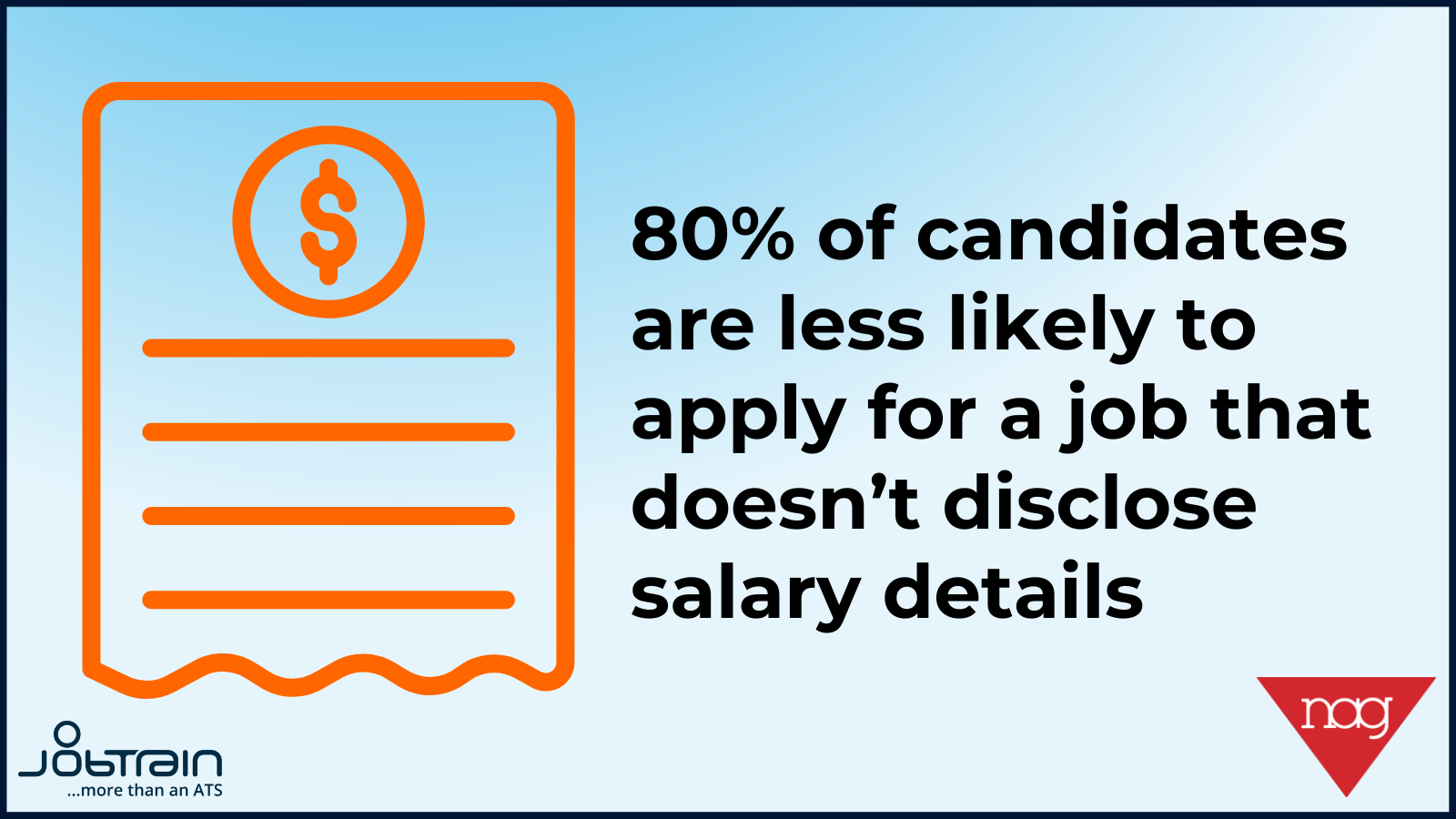
Eight in ten candidates now avoid applying for roles that don't include salary information, according to Totaljobs' 2026 Salary Trends Report. For many, no salary range means no application. They’re ruling your roles out before you've even seen their CV.
Pay transparency has moved from a progressive HR talking point to a basic recruitment expectation. With EU member states required to implement the EU Pay Transparency Directive by 7 June 2026, and the UK government consulting on similar measures, the direction of travel is clear.
Here's what UK employers need to know, and what you can do about it, and how platforms like Jobtrain make it easier to do consistently.
What is pay transparency?
Pay transparency is when you openly communicate your salary ranges, pay structures, and the criteria used to set and progress pay with candidates and employees. It ranges from voluntarily disclosing salary ranges in job adverts to legally mandated reporting and pay gap disclosure.
Pay transparency isn't binary. Most UK employers are doing some version of it already. Many publish salary ranges for some roles, or at least share pay bands during the offer stage.
.png?width=1600&height=900&name=Talent%20Insights%20Report%20Q1%2026%20-%20featured%20(1).png) Download our 2026 Talent Insights Report
Download our 2026 Talent Insights Report
The question in 2026 is whether that transparency is consistent, whether it's presented early enough in the process to influence candidate decisions, and whether what you're publishing is actually competitive with current market rates instead of just saying it is.
UK employers aren’t currently legally required to advertise salary ranges. Expectations have moved faster than legislation, but UK law isn’t lagging far behind the EU. In 2025, the UK government ran a call for evidence on equality law that included potential pay transparency measures such as salary ranges in job adverts and restrictions on salary history questions. Legislation is generally expected to follow.
Why does pay transparency matter for recruitment?
According to the Totaljobs Report, 89% of candidates are more likely to apply when a salary range is listed, and 83% say a missing salary negatively affects their opinion of the employer. Salary remains the top factor in job decisions for 80% of workers.
When you publish the range, candidates can quickly judge whether the role is financially viable for them before applying. This self-selection effect is where transparency really pays off. When candidates can see the range, those whose expectations don't align simply won't apply. You end up with a better shortlist, spend less time screening, and have a faster time-to-hire.
There's an employer branding dimension to it, too. Candidates treat pay secrecy as a signal about culture. Salary disclosure also reinforces equity: it reduces the negotiation gaps that consistently disadvantage women and underrepresented groups.
The gap between expectation and reality is where the opportunities live. HR DataHub's analysis of 2.8 million UK job ads found that 24% still don’t include a salary range. The gap widens sharply at senior levels: only 39% of employers publish Director-level pay ranges compared to 67% for frontline roles.
If you publish clear ranges and the criteria behind them for senior roles, you can stand out in a part of the market where transparency is still uncommon. Even better, you’re more likely to attract applicants whose expectations match your budget.
For a closer look at how candidate expectations are shifting and what transparent job ads actually need to include, Jobtrain's guide to pay transparency in job ads covers the policy and template side in detail.
How to set a defensible salary range in 5 easy steps
Before you publish anything, you need a range you can stand behind. If a candidate asks, “Why is it £X–£Y?”, you should be able to answer in one sentence. This is a quick way to get there:
- Benchmark the market: Use up-to-date data for similar roles (level, location, sector).
- Set the midpoint: Pick the salary for someone who meets the requirements comfortably.
- Choose the width: Keep it tighter for standard roles; widen it only where scope or scarcity justifies it.
- Write placement rules: Define what puts someone low, mid, or high in the band (skills, experience, impact).
- Make it repeatable: Agree who signs it off, and when it’s reviewed, so ranges don’t drift or go stale.
With the range agreed, you can focus on the rest of the advert: benefits, progression, and the context candidates need to self-select properly.
 How to write transparent job postings
Most guidance on pay transparency stops at 'include a salary range.' That's the floor. Here's what good actually looks like.
The minimum: what to include
Every job advert should state a salary range and a basic benefits summary. That means a floor and a ceiling, not a single figure. A range shows you've thought about the role. A ceiling-only figure looks like you're anchoring low. Cover the essentials on the types of employee benefits on offer: pension contribution, leave entitlement, any bonus structure, and standout perks relevant to the role.
Best practice: how to make a stand-out transparent job post
The employers seeing the best results from transparency aren't just publishing a number and ticking it off their to-do list. They're giving candidates enough context to genuinely assess the role.
A strong, transparent job posting includes:
- Role-specific salary range (not a company-wide band)
- Location context if relevant (e.g. London weighting, remote pay policy)
- Where the range sits relative to market, e.g. 'benchmarked against current market data'
- Bonus/commission structure and eligibility criteria
- Clear criteria for where a candidate lands in the range (experience, skills)
- Benefits summary: pension %, leave, hybrid/remote arrangement
- A note on review cycle, e.g. 'ranges reviewed annually'
Setting a range that reflects live market conditions requires current data. Using last year's survey benchmarks risks offering ranges already behind the market, and candidates notice.
Salary benchmarking against current job advert data gives you a real-time view of what equivalent roles are paying. Monitoring UK pay trends alongside your own benchmarks helps ensure your ranges stay defensible as the market moves.
What should you avoid when adding salary ranges to job adverts?
'Competitive salary' is the single biggest signal that transparency is missing. Candidates interpret it as 'we're paying below market' or 'we haven't done the work'. Neither is the impression you want.
Ranges wider than 30–40% of the midpoint look like placeholders rather than genuine offers. A £30,000–£55,000 band for a single role raises more questions than it answers.
Watch the timing too. Ranges published before your last pay review can mislead candidates and create friction at the offer stage. Align your review cycle with your recruitment calendar so advertised ranges are always current.
Consistency is important too. Advertising salaries for some roles but not others creates a two-tier impression. Candidates notice, and so do your existing staff.
 Before and after: what the difference looks like
Before (don’t do this)
Customer Service Manager
Salary: Competitive
We're looking for an experienced customer service manager to join our growing team. You'll lead a team of 12 advisors and report to the Operations Director.
After (do this!)
Customer Service Manager
Salary: £38,000–£44,000 (depending on experience)
You’ll lead a team of 12 advisors and report to the Operations Director.
We typically offer £38–£40k for candidates stepping up, and £41–£44k for those with proven people-leadership and KPI delivery. Eligible for an annual bonus up to 10% (based on team performance).
Hybrid working, 25 days’ leave + bank holidays, and 5% employer pension contribution. Ranges are benchmarked against current market data and reviewed annually in April.
Keeping it consistent at scale
One of the practical challenges of pay transparency is consistency, especially when hiring across multiple roles, teams, or locations. When each hiring manager writes their own advert, salary disclosure becomes patchy, ranges drift, and your employer brand suffers.
The fix is to build transparency into your process: salary ranges in templates, not added at the last minute. Jobtrain's ATS lets you embed salary ranges and disclosure requirements directly into job advert templates, so every posting goes out consistently, regardless of who wrote it. Explore Jobtrain's recruitment features to see how it works in practice.
What does the EU Pay Transparency Directive mean for UK employers?
The EU Pay Transparency Directive entered into force in June 2023. EU member states must implement it into national law by 7 June 2026, after which employers across the EU must disclose salary or salary range before interview and are banned from asking candidates about salary history.
The UK isn't bound by it post-Brexit, but UK employers certainly aren't insulated from its effects. Organisations with EU operations will need to comply with local implementations and potentially similar changes at home in the relatively near future.
Employers that get ahead of the game by publishing their salary ranges consistently now and building that into their job advert process will be better placed if and when domestic rules arrive.
.png?width=720&height=369&name=Testimonials%20quotes%20720px%20wide%20(5).png) Final thoughts
Final thoughts
Pay transparency is no longer something to think about maybe phasing in at some point. Candidates are making decisions based on what you do or don’t disclose before they ever speak to your team. Start with your job adverts, make sure your ranges are based on current data, and build disclosure into your templates so it happens consistently.
Jobtrain makes that last part straightforward. Book a demo today to see how structured templates and ATS workflows take the inconsistency out of transparent hiring.
About the authorDavid Whitfield is the CEO and co-founder of HR DataHub, a salary benchmarking tool that draws data from over 30 million live job postings to help HR teams make confident, data-driven pay decisions. With more than 20 years of experience in HR and Reward, he is passionate about empowering organisations to make smart, defensible decisions more quickly and easily than ever before. |