It’s been a perennial challenge that hiring teams often measure success differently.
One counts time to hire from vacancy approval, the other from the day the job goes live. Some tracks offer acceptance by role, others don’t track it at all. This inconsistency has made it hard to benchmark hiring or to prove how recruitment is performing relative to the competition, other organisations within a sector, geography or nationally.
The National Hiring Metrics were built to close that gap and finally enable a true to picture of national recruitment and hiring performance. Developed by the Better Hiring Institute and the Resourcing Leaders community (RL100) and discussed, reviewed and agreed by more than 60 senior resourcing leaders from major UK employers. Together they set out nine standard definitions and formulas for measuring hiring.
The framework had its soft launch at the House of Lords on 19th March 2026 and its full launch at RecFest UK on 2nd July 2026, presented by Keith Rosser and Adrian Thomas.
Jobtrain is proud to be an early adopter by being one of the very first applicant tracking systems to build reporting against this new standard, giving our customers a consistent, board-ready way to measure hiring performance.
.png?width=800&height=284&name=Canva%20-%20reporting%20national%20metrics%20(1).png) What the National Hiring Metrics measure
What the National Hiring Metrics measure
The nine measures cover the full hiring path, from how candidates are sourced through to time to start and outcomes after hire. The idea is simple: agree the definitions once, so every employer, ATS and recruitment partner is counting the same thing in the same way.
Read more details on the National Hiring Metrics here.
The National Hiring Metrics Jobtrain reports on today
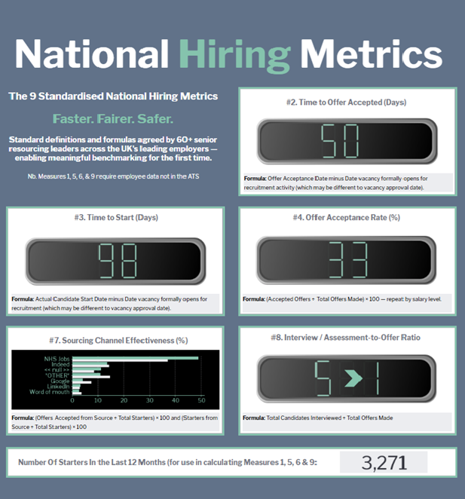
Five of the nine measures can be calculated directly from data already held in an ATS. These are the ones we have built into Jobtrain's reporting suite:
-
Time to Offer Accepted (Days). Offer Acceptance Date minus the date the vacancy formally opened for recruitment activity.
-
Time to Start (Days). Actual candidate start date minus the date the vacancy formally opened for recruitment activity.
-
Offer Acceptance Rate (%). Accepted offers divided by total offers made, multiplied by 100, tracked by salary level.
-
Sourcing Channel Effectiveness (%). Offers accepted from a source divided by total starters from that source, multiplied by 100.
-
Interview/Assessment-to-Offer Ratio. Total candidates interviewed compared with total offers made.
The other four measures (including starter volumes and outcomes tracked after the hire date) need employee data that sits outside of the applicant tracking system, usually in payroll or HR systems instead. We are honest about that limit. We have built solid reporting for the five measures an ATS can genuinely own and we are working with the framework's authors on adopting and supporting future metrics as they are agreed in future.
.png?width=800&height=524&name=Canva%20-%20Reporting%20image%20(1).png) Why this matters for hiring teams
Why this matters for hiring teams
A shared standard means less time spent debating definitions. Allowing organisations to use standard metrics to turn hiring data into information, then into insight and finally into action. It also means a hiring team can, for the first time, compare its own performance against a national benchmark rather than against last year's individual performance.
Hiring teams have never had a shared, trusted way to measure performance that can be benchmarked against peers or nationally. Building the National Hiring Metrics directly into Jobtrain's reporting gives our customers data they can share and act on immediately, without manual calculations or building these reports outside of the platform.
Gary Towers, Director of Talent Intelligence, Jobtrain
Frequently asked questions
What are the National Hiring Metrics?
The National Hiring Metrics are nine standardised recruitment measures, agreed by the Better Hiring Institute and Resourcing Leaders (RL100) with over 60 senior UK resourcing leaders, giving employers common definitions for measuring hiring performance.
Why were the National Hiring Metrics introduced?
Before the framework existed, employers, ATS providers and recruitment partners each measured hiring differently. That made it hard to benchmark performance or prove hiring's impact to a board. A shared standard means everyone counts the same thing in the same way.
Which National Hiring Metrics does Jobtrain report on?
Jobtrain reports on time to offer accepted, time to start, offer acceptance rate, sourcing channel effectiveness, and interview to offer ratio. These are the five measures that can be calculated from data already held in an ATS.
See your own National Hiring Metrics
Want to see these five reports run against your own hiring data? Book a 20-minute walkthrough with our team and we will show you exactly what your dashboard would look like.