The latest edition of the Jobtrain Talent Insights Report brings together recruitment data, jobseeker behaviour and wider labour market trends to provide talent acquisition leaders with a clear picture of what is happening across the hiring landscape.
Drawing on analysis of 20,000 vacancies across 18 sectors and 12,500 jobseeker survey responses, our latest report highlights how hiring is evolving as economic caution, technology and candidate expectations reshape recruitment. You can explore the full findings in the Talent Insights Report 2026: recruitment trends and insights.
Here are eight key insights every talent acquisition and HR leader should understand.
1. Most hiring is replacing people, not growing teams
One of the clearest signals in the report is that recruitment is largely driven by replacement hiring rather than organisational growth.
Around 78% of roles analysed were created to replace employees who had left, while only around 20% represented genuine business growth.
This shift changes the conversation for talent leaders. Recruitment can no longer be viewed in isolation. Retention, internal mobility and workforce planning play a critical role in reducing the costly cycle of hiring, onboarding and backfilling roles.
Organisations that treat retention as part of their hiring strategy will be far better placed to stabilise their workforce and improve time to hire. The Talent Insights Report 2026 explores how organisations can adapt their hiring strategies in more detail.
.png?width=483&height=435&name=78%20percent%20of%20recruitment%20driven%20by%20replacement%20roles%20(1).png)
2. The labour market is cooling – but not collapsing
While hiring activity has slowed compared with the intense competition of recent years, the labour market remains active.
UK data shows vacancies remain historically high at around 730,000 roles, although slightly lower year on year. At the same time, unemployment has risen modestly to around 5.2%, signalling a gradual shift towards a more balanced market.
For employers, this creates a nuanced environment. There may be more candidates available, but that does not necessarily mean the right skills are easier to find.
As highlighted in the Talent Insights Report 2026: recruitment trends and insights, recruiters must focus on precision in attraction and selection rather than simply relying on volume.
3. Competition for talent varies dramatically by sector
Not every industry is experiencing the same hiring pressures.
Some sectors – particularly frontline or service roles such as Leisure and Hospitality – see extremely high application volumes per vacancy. Others, including education and specialised professional roles, continue to struggle with tight candidate supply.
This uneven competition means organisations need sector-specific recruitment strategies.
The Talent Insights Report 2026 breaks down how application pressure varies across sectors and what recruiters can do to respond effectively.
4. External hiring still dominates recruitment
Despite the growing conversation around internal mobility, most organisations still hire primarily from outside the business.
Our analysis shows that around 91% of hires are external, compared with roughly 8% filled internally and just 1% through agencies.
While external recruitment will always play a role, this data highlights a major opportunity for organisations to strengthen internal career pathways.
The Talent Insights Report 2026 explains how organisations can improve internal mobility and reduce reliance on external hiring.
5. Indeed, LinkedIn and careers sites drive most applications
The report confirms what many talent teams already suspect: a small number of channels deliver the majority of applications.
The most common sources of external applications were:
- Indeed – around 40% of applications
- LinkedIn – around 26%
- Company careers websites – around 25%
Interestingly, hires are more likely to come through careers sites and Indeed rather than social platforms alone.
As discussed in the Talent Insights Report 2026, this reinforces the importance of optimising your careers site and application journey.
.png?width=800&height=346&name=Market%20report%20Q1%2026%20survey%20data%20(1).png)
6. Mobile applications now dominate candidate behaviour
The way candidates apply for roles continues to evolve.
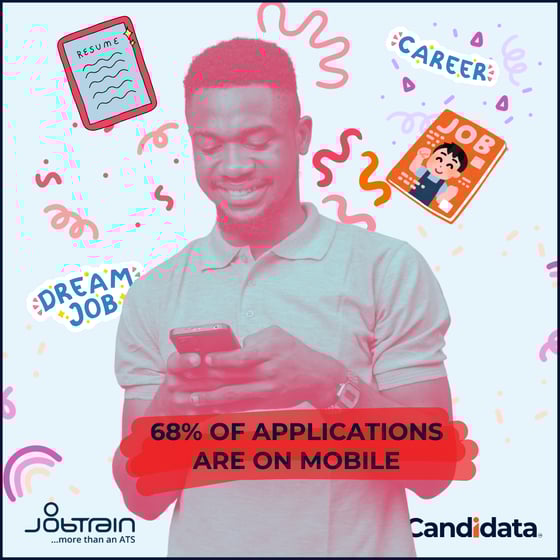
Across all sectors, around 68% of applications are now submitted on mobile devices, with some frontline industries exceeding 80%.
For recruiters, this means mobile-first design is no longer optional. Long application forms, poor usability or slow mobile experiences can significantly increase candidate drop-off.
The Talent Insights Report 2026 highlights why features such as autofill, shorter forms and “save and return” functionality are becoming essential to maintaining strong completion rates.
7. Career progression is the biggest reason people look for a new job
When jobseekers were asked why they began their job search, career progression emerged as the leading motivator, cited by around 38% of respondents.
Other key drivers included concerns about job security and career change.
For employers, this insight reinforces the importance of clearly communicating development opportunities.
The Talent Insights Report 2026 explores how progression pathways, learning opportunities and internal mobility influence candidate decisions.
8. Accessibility and fairness are becoming critical hiring factors
Candidate experience is no longer just about convenience. Accessibility and fairness are becoming central to recruitment strategy.
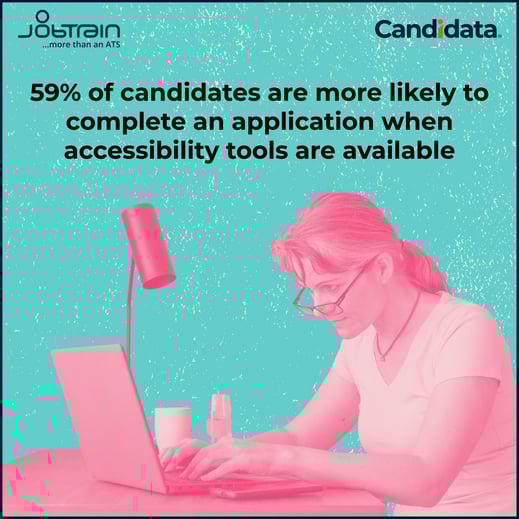
The report shows that around 59% of candidates say accessibility tools make them more likely to complete an application, highlighting the importance of inclusive design.
At the same time, conversion rates between stages of the hiring process can vary across demographic groups. Organisations need to regularly review recruitment data to ensure their processes remain fair, transparent and inclusive.
You can read more about improving inclusive hiring practices in the Talent Insights Report 2026: recruitment trends and insights.

What this means for talent acquisition leaders
Taken together, the findings from our latest insights report paint a clear picture of the current recruitment landscape.
Hiring in 2026 is defined by economic caution, rising candidate supply and rapidly evolving technology, while expectations around fairness, accessibility and career development continue to grow.
For talent leaders, success will come from focusing on three priorities:
- Hiring with clear intent and strong data
- Rewarding employees with transparent and credible packages
- Developing talent internally rather than relying solely on external hiring
To explore the full research, download the Talent Insights Report 2026: recruitment trends and insights and dive deeper into the data shaping recruitment today.